Exploring Guangxi’s must-sees: where songs, silk and villages tell their stories
From mountain chants echoing across valleys to silk threads travelling from rural workshops to global fashion houses, a journey through Guangxi reveals how ethnic culture, innovation and community revival come together. Rather than preserved behind glass, traditions here remain alive — sung, woven and lived — inviting visitors to listen closely to stories shaped by people and place.
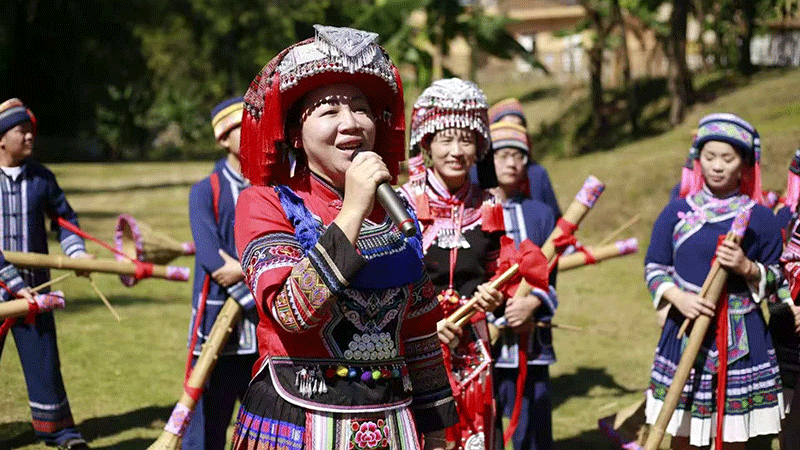 |
For the Gongnui Yao people, songs serve as messages of welcome to visitors. --PhotoPool
|
Voices that cross valleys
In the deep mountains of Dahua Yao Autonomous County in Hechi, Guangxi, sound arrives before sight. A powerful voice rises from one hillside and is answered from another across a vast green valley. This is the Gongnui Yao people’s Shouting Song, a centuries-old chant once essential for communication among villagers working high on rugged terrain.
Long before paved roads and mobile phones reached these mountains, such songs carried messages, emotions and rituals across distances ordinary speech could not bridge. Today, the valleys are quieter, but the songs endure. Led by dedicated inheritors and supported by a new generation of young singers, the Shouting Song has shifted from daily necessity to cultural treasure, still retaining its raw intensity and spiritual depth.
Listening to the chant feels less like attending a performance and more like stepping into a dialogue between humans and nature — one that has echoed here for generations.
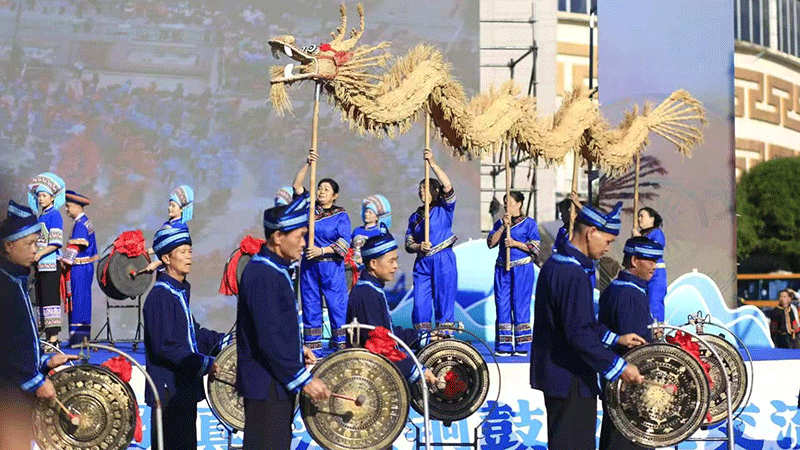 |
Yao people welcome tourists with a traditional bronze drum performance. --PhotoPool
|
When empty villages fill with life again
Not far away, another story unfolds — this time through movement, colour and renewed energy. Once labelled a “hollow village” due to youth migration, Qingrenwan in Dahua has reinvented itself through tourism.
Today, guesthouses line the water’s edge, bronze drums sound during festivals, and visitors gather for long-table feasts featuring Yao cuisine. By day, water sports animate the river; by night, bonfires and traditional dances bring locals and visitors together.
Tourism has done more than attract visitors. It has drawn young people home, created new income streams and transformed abandoned land into shared community assets. What was once defined by absence is now shaped by presence, and by confidence in a future rooted in culture.
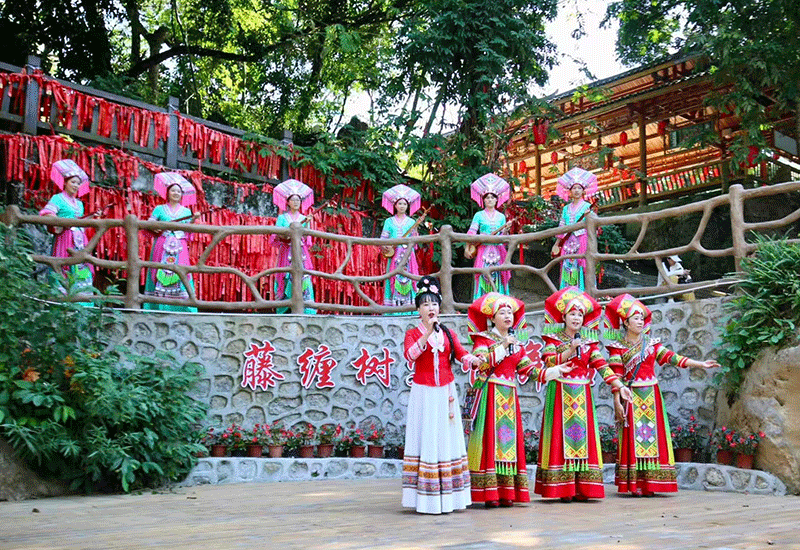 |
A singer (left) performs as the legendary “Song Fairy” Liu Sanjie to entertain visitors. --PhotoPool
|
An ocean of folk songs
Hechi is widely known as the hometown of Liu Sanjie, the legendary “Song Fairy”, and is often described as an “ocean of folk songs”. In Yizhou District, that reputation is fully lived rather than staged.
At the Liu Sanjie Hometown Scenic Area, visitors don traditional Zhuang attire, step onto wooden boats and exchange improvised songs across the water. The performances are playful and poetic, filled with humour, challenge and everyday wisdom. Mountains and rivers amplify the melodies, drawing in tourists and passersby alike.
What begins as a guided experience quickly becomes spontaneous. Spectators become participants, discovering how folk songs here remain a living language — not something remembered, but something practised.
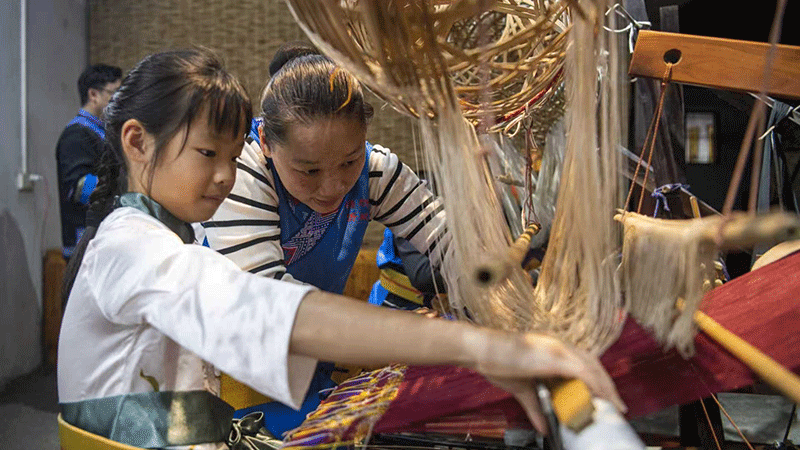 |
Zhuang brocade weaving is being revitalised by a new generation of young artisans. Pool photo.--PhotoPool
|
Threads that carry history forward
Further south in Xincheng County, the journey shifts from sound to texture. Inside historic Tusi-era buildings, bamboo-cage looms hum steadily as Zhuang brocade takes shape thread by thread.
Once woven in nearly every household, the craft faced decline with industrialisation. Today, it is enjoying a revival led by young artisans who combine ancestral skills with digital design tools. Ancient motifs are reinterpreted with modern colour palettes, while patterns are mapped using computer software to speed up production and expand creative possibilities.
The result is Zhuang brocade that travels well beyond Guangxi, appearing in contemporary fashion, accessories and home décor in overseas markets. Visitors witness how tradition can evolve without losing its essence.
 |
A modern silk workshop is transforming an industry once reliant on experience into one driven by innovation.
|
A modern Silk Road, one thread at a time
Beyond the looms, silk continues its journey. In Xincheng’s mulberry fields and factories, sericulture has entered a high-tech era.
Automated irrigation nourishes mulberry trees, while climate-controlled workshops ensure consistent silk quality. Sensors regulate temperature and humidity, transforming an industry once dependent on experience and weather into one driven by precision and innovation.
This modern silk chain supports tens of thousands of rural households and connects Guangxi directly to markets in ASEAN, Europe and beyond. For visitors, it offers a rare look at how an ancient industry is being reimagined, not replaced, by technology.
 |
A mid-air bookstore invites visitors to pause and read above the abyss.
|
From the bottom of a sinkhole to the top of a map
The journey ends dramatically in Luocheng Mulao Autonomous County, at Mianhua Tiankeng — a vast karst sinkhole once synonymous with isolation and poverty.
Instead of reshaping the landscape, development here has worked with it. Cliffside hotels cling to rock walls, glass walkways reveal dizzying depths, and a mid-air bookstore invites visitors to pause and read above the abyss. Adventure and reflection coexist in equal measure.
For Mulao villagers, tourism has brought jobs, opportunity and renewed pride. Former migrant workers now run homestays, cultural performances attract visitors, and young people see a future at home rather than elsewhere.
At night, bonfires glow within the sinkhole, laughter replaces silence, and the mountains seem to listen once more.
 |
|
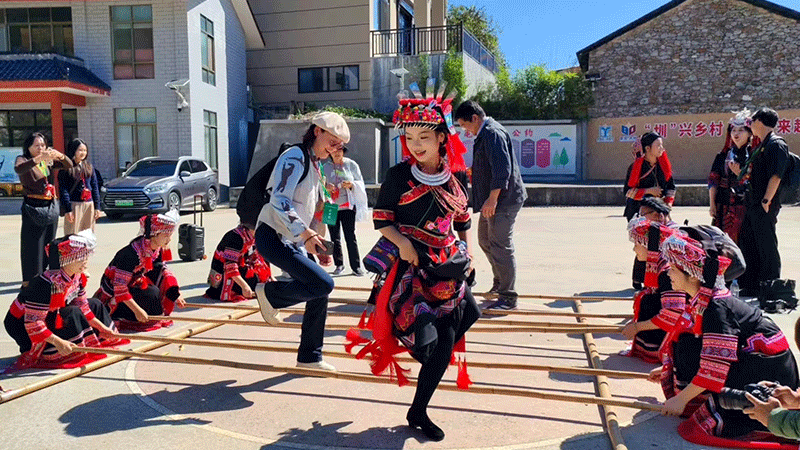
Visitors enjoy a bamboo dance in Dahua Yao Autonomous County. Pool Photo
|
A landscape that speaks back
Travelling through Guangxi is not about ticking destinations off a list. It is about listening to songs shouted across valleys, to looms humming with memory, and to villages rediscovering their voice.
Here, culture is not frozen in time. It adapts, invites participation and continues to speak, clearly and confidently, into the present. For those willing to listen, Guangxi tells its stories not only through landscapes, but through the people who keep them alive.
 |
Gongnui Yao people and visitors enjoy a cruise trip.
|
By Vassana Sisomvang and Ekthavone Danlongboun
(Latest Update December 31, 2025)
|

