 |
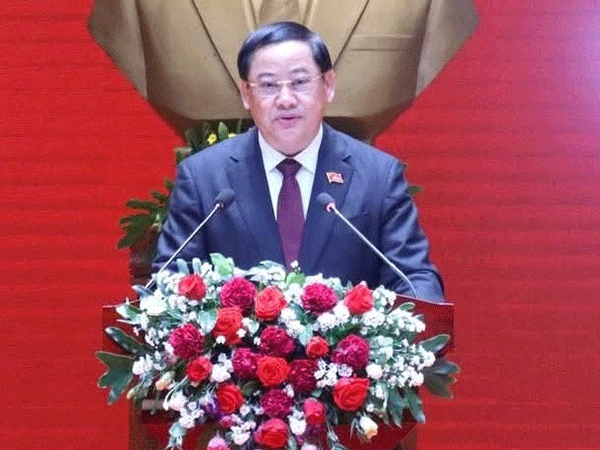
| Prime Minister Sonexay Siphandone. |
New national development plan targets heritage recognition, economic growth
The government will seek international recognition for iconic Lao cultural traditions and natural treasures while also setting ambitious targets in education, health, poverty reduction, and infrastructure under the new 10th National Socio-Economic Development Plan covering the period 2026-2030.
Prime Minister Sonexay Siphandone announced these targets at a national meeting held last week to discuss ways to put into practice the resolutions adopted by the 12th National Party Congress last month.
The meeting signalled the start of implementation of the new National Socio-economic Development Plan, which sets out a comprehensive roadmap aimed at accelerating sustainable development and strengthening regional integration.
In a bid to raise Laos’ profile internationally, the government plans to nominate several traditions for inclusion in UNESCO’s Intangible Cultural Heritage of Humanity list.
These including the popular spicy beef salad known as laap, the Baci ceremony, PuYer and YaYer (revered ancestor spirits that are symbolic mascots of the Lao New Year festival in Luang Prabang), Lao New Year itself, khao tom (steamed sticky rice with banana), and khao lam (sticky rice steamed in bamboo tubes).
In parallel, authorities will pursue World Heritage status for the Nakai-Nam Theun National Park, the Plain of Jars in Huaphan province, and the That Ing Hang stupa in Savannakhet province.
In the field of education, the target is for 90 percent of five-year-olds to be enrolled in school, and to keep the dropout rate in lower secondary schools below 8 percent. Authorities also aim to produce 50,000 graduates from vocational and technical training programmes over the next five years.
Health sector goals include reducing the newborn mortality rate to less than 10 deaths per 1,000 live births, and cutting the under-five mortality rate to less than 25 deaths per 1,000 live births.
Labour and social welfare measures will focus on providing skills training for 650,000 people and facilitating job placement for 411,000 workers in domestic and overseas markets.
The government also aims to reduce the national poverty rate to a single digit figure and lift more than 100,000 families out of poverty, while lowering acute malnutrition among children under the age of five to 5 percent.
Environmental priorities also feature prominently in the development plan, with targets to increase national forest cover to 70 percent and issue 150,000 titles for land outside forest areas.
Another goal is to reduce greenhouse gas emissions and enhance absorption capacity by 60 percent.
In addition, meteorological coverage will be expanded to 35 underserved districts, and 25 hydrological stations will be installed in flood-prone areas to strengthen disaster preparedness.
To bolster regional integration and trade, authorities plan to build or upgrade 937.5 kilometres of highways along ASEAN economic corridors, ensuring they are of sufficiently high quality to withstand an 11-ton axle load without damage.
Government agencies are also instructed to cut import-export processing times by 45 percent by 2030 and to increase the share of exports under preferential trade schemes to 65 percent of total export value.
In governance and public administration, the government intends to transform three provinces into strategic units, 18 districts into comprehensively strong units, and 640 sub-districts into development units.
In the justice sector, the target is for at least 90 percent of criminal cases and over 75 percent of civil cases to be resolved within the plan’s timeframe.
The goals set out in the 10th five-year development plan underscore the government’s determination to safeguard national heritage, promote inclusive growth, and build a resilient economy that is capable of meeting regional and global challenges by 2030.
By Times Reporters
(Latest Update March 5, 2026)
|

