 |
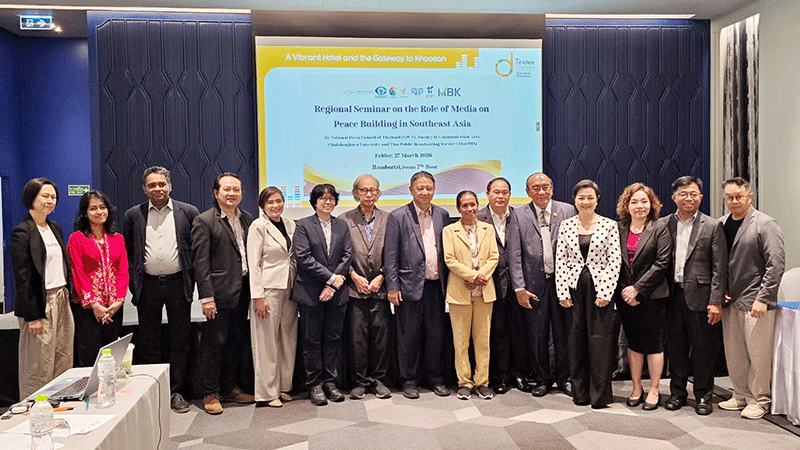
| Mr Chavarong Limpattamapanee, Chairman of the National Press Council of Thailand (centre), poses for a photo with representatives of journalists’ associations and media outlets from Southeast Asian countries at a seminar titled “The Role of Media in Peacebuilding in Southeast Asia”, held in Bangkok on March 26. |
Southeast Asian journalists forge new path for peace
At a landmark seminar in Bangkok, media leaders from across the region committed to transforming their role from passive chroniclers of conflict to active architects of understanding, confronting internal divides and the challenges of the digital age.
In a world saturated with polarising narratives and digital discord, a powerful counter-movement is taking root in Southeast Asia. On March 27, in a conference room in Bangkok, a quiet but profound revolution in journalism began, not with a shout, but with a commitment to introspection.
Hosted by the National Press Council of Thailand, the Regional Seminar on the Role of Media on Peace Building brought together over 30 representatives from media outlets and journalist associations in Cambodia, East Timor, Laos, Malaysia, Myanmar, Sri Lanka and Vietnam.
The gathering, held as part of the General Assembly of the Southeast Asian Press Council Network, was a collective soul-searching on how an industry often accused of amplifying conflict can instead become its antidote.
The Journalist as Peacebuilder
Assoc. Prof. Alongkorn Parivudhiphongs of Chulalongkorn University’s Faculty of Communication Arts laid out the new mandate. He described the modern journalist not merely as a reporter, but as a “builder of narratives, a platform for dialogue, a watchdog, an educator, and an agent of de-escalation”.
It was a theme echoed with profound earnestness by Mr Kavi Chongkittavorn, an honorary member and Chairman of the International Committee of the National Press Council of Thailand. “I want to emphasise that we, journalists, have an important role to play,” he said, his words carrying the weight of decades of experience.
“We, ourselves, have to be clear in our own minds, at peace, and be trustful, so that when we go out, we can really do our job very well.”
Mr Kavi pushed further, challenging his colleagues to look inwards. “All the peace-related topics must come from journalists who are at peace with themselves,” he said. “If journalists do not have a peaceful mind, do not really come to terms with themselves peacefully, there is no way they can contribute to peace building in all domains, in all platforms. So they will have to do a lot of soul searching.”
A Nation in Transition: The View from Laos
This philosophy of mindful journalism was given tangible form in a country report delivered by an executive member of the Lao Journalists Association. Standing before distinguished delegates, the representative painted a portrait of a media landscape at a critical crossroads.
With a population of 7.9 million, Laos is navigating the twin storms of rapid technological change and global economic instability. The report noted a dramatic shift from over 100 print publications a decade ago to just six daily newspapers today, with many outlets migrating online. Connectivity is soaring, with 85.2 percent of the population having mobile connections, and media outlets embracing platforms like Facebook, YouTube, TikTok, and even AI technology, with some broadcasters now using AI-generated announcers.
Yet, amid this digital transformation, the Lao Journalists Association is consciously steering its members towards a higher purpose.
With support from the European Union, they have conducted training on green and sustainable development, focusing on Sustainable Development Goal 16: Peace, Justice, and Strong Institutions.
The report’s most compelling section was a manifesto on peacebuilding, stating that “media serves as a powerful, yet often underutilised, pillar of peacebuilding by transforming the very environment in which conflict festers”.
It argued for a shift from simply reporting on violence to actively de-escalating tensions by providing a platform for non-violent perspectives and countering hate speech with facts.
A Future Forged in Dialogue
The delegates acknowledged the formidable challenges ahead. The Lao representative noted the tangible impact of global conflicts on daily life in Laos, from rising fuel prices to economic strain. They also highlighted the pressing need for updated media laws and ethical codes to govern the use of artificial intelligence, ensuring audiences can distinguish between human-created and AI-generated content.
A key point of discussion was the delicate balance between regional cooperation and the ASEAN principle of non-interference.
The seminar proposed a novel way forward: media literacy programmes focused on understanding this very principle. The idea is that by fostering a shared, nuanced understanding of each nation’s sovereignty, journalists can build trust and protect regional stability from external pressures.
As the seminar concluded, the commitment was palpable. The Lao Journalists Association, speaking for many, expressed an eagerness to deepen cooperation with its neighbours to combat disinformation, misinformation, and online scams.
In the end, the event in Bangkok was more than a seminar. It noted that in a region often defined by its diversity and complexity, the media has the power—and now, the clear mandate—to be not just a mirror reflecting the world’s conflicts, but a bridge leading towards its peace.
By Times Reporters
(Latest UpdateApril 1, 2026)
|

