 |
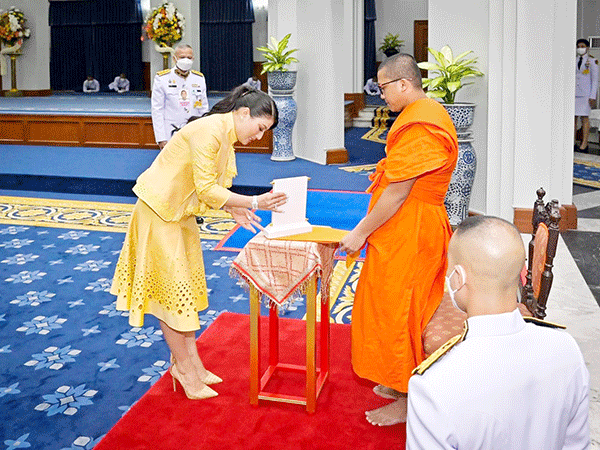
| Dr Phaivanh Malavong receives a S.E.A. Write Award. |
Phaivanh Malavong: A guardian of Lao literary heritage
In a quiet temple in Vientiane, surrounded by stacks of manuscripts and the echoes of ancient teachings, Phaivanh Malavong continues a lifelong mission—one that goes beyond writing books. It is a mission to protect the soul of a nation.
At a time when globalisation is reshaping cultures and modern life is accelerating change, the risk of losing traditional knowledge has never been greater. Languages evolve, customs fade, and stories once passed down through generations can quietly disappear. Yet for Phaivanh, this is not an inevitable loss—it is a challenge to be met with dedication and purpose.
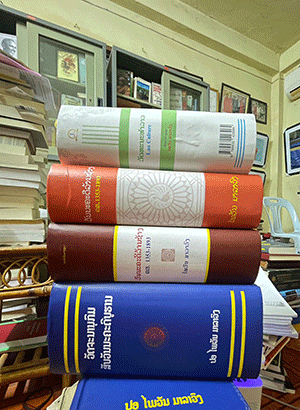 |
| These books, compiled by Dr Phaivanh, contain valuable insights into Lao culture and traditions, serving as a rich source of knowledge for those who wish to study Lao culture in depth. |
Born in 1990 in Donkaden village, Khong district, Champasak province, his journey into literature began not in a classroom, but through curiosity. While many children were still discovering their interests, he was already experimenting with storytelling. By the time he reached Grade 2 of secondary school, he was writing his own stories, captivated by the power of words.
Growing up in southern Laos, he was immersed in a world filled with oral traditions, cultural rituals, and community life. These early experiences shaped his thinking. The stories he heard, the customs he observed, and the values he absorbed would later influence not only his writing, but his life’s purpose.
What began as a childhood passion gradually transformed into something deeper—a commitment to understanding and preserving Lao identity.
As he grew older, his curiosity expanded beyond storytelling into the study of literature, culture, and religion. He came to see that these were not separate fields, but interconnected threads that define who people are and where they come from.
This realisation led him to pursue an in-depth study of Buddhism, a path that would profoundly influence his intellectual and creative work. In 2020, he earned a Doctor of Philosophy in Buddhism from Mahachulalongkornrajavidyalaya University in Thailand. More than an academic achievement, the experience deepened his understanding of ethics, human nature, and spirituality—elements that resonate throughout his writing.
Over the years, Dr Phaivanh has built a remarkable literary career. Since 2002, he has written more than 100 books—a body of work that spans cultural studies, literary criticism, fiction, poetry, and more. His writing is not confined to one genre or audience; instead, it reflects a broad and inclusive vision of literature as a tool for both expression and preservation.
His creativity does not stop at the written word. As a songwriter, he has found another way to connect with people, blending traditional values with contemporary forms. Whether through books or music, his goal remains the same: to keep Lao culture alive and meaningful for future generations.
Yet among all his achievements, one project stands above the rest in both ambition and impact.
For 15 years, he worked tirelessly on a monumental task—the compilation of a dictionary of ancient Lao literary vocabulary. At a time when classical texts are becoming increasingly difficult for modern readers to understand, he recognised the need to bridge the gap between past and present.
The result is extraordinary: a comprehensive volume containing more than 59,000 entries across 2,030 pages. Within its pages are not only words, but the echoes of history—idioms, expressions, and meanings that capture the depth and beauty of classical Lao literature.
Weighing around 3 kilograms, the dictionary is as physically substantial as it is intellectually significant.
At the heart of this work lies a simple but powerful belief. “If a nation loses its language and literature, it risks losing its identity. Writing is not only creation—it is the preservation of who we are,” Dr Phaivanh said.
This philosophy defines everything he does. For him, literature is not merely an art form; it is a living archive of culture, memory, and identity.
The publication of the dictionary during the Lao PDR’s 50th anniversary added symbolic weight to the achievement. It was more than a book launch; it was a statement about the importance of remembering, preserving, and valuing the nation’s roots in a rapidly changing world.
His contributions have not gone unnoticed. Over the years, he has received numerous awards and recognitions, including the prestigious S.E.A. Write award in 2019 and the Mekong River Literature Award in 2015. These honours reflect not only his talent, but also the respect he has earned within literary and academic communities.
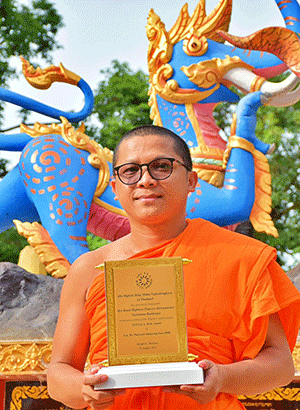 |
| Dr Phaivanh Malavong. |
Those who know him say he is not driven by recognition. Instead, he is known for his discipline, humility, and unwavering focus. Writing, for him, is not a pursuit of fame—it is a responsibility.
Beyond his role as a writer, Dr Phaivanh serves as an educator and spiritual leader. As the abbot of Sixomxeun temple in Sikhottabong district, Vientiane, he balances religious duties with scholarly work, embodying a life where knowledge and spirituality go hand in hand.
He also teaches Master’s and PhD students at the National University of Laos on weekends, sharing his expertise with the next generation of scholars. In the classroom, as in his books, his message is consistent: knowledge must be preserved, understood, and passed on.
His journey—from a young boy in Champasak with a love for storytelling to a nationally respected scholar—illustrates the power of purpose. It shows how dedication, when guided by a clear vision, can lead to lasting contributions that extend far beyond an individual’s lifetime.
Looking ahead, Dr Phaivanh shows no signs of slowing down. He plans to continue writing, researching, and engaging in cultural work, with a growing interest in exploring the connections between literature, culture, and spirituality. At the same time, he hopes to mentor emerging writers, recognising that the future of Lao literature depends on nurturing new voices.
In an age where modern influences can easily overshadow tradition, insightful individuals like Phaivanh Malavong remind us of the importance of balance. Progress does not have to come at the cost of identity. Instead, it can coexist with a deep respect for heritage.
Through his work, he has ensured that the stories, language, and wisdom of the past remain accessible in the present and relevant for the future.
In doing so, he has not only preserved Lao literary heritage but has made it more meaningful and elevated its importance.
By Phon Thikeo
(Latest UpdateApril 23, 2026)
|

