 |
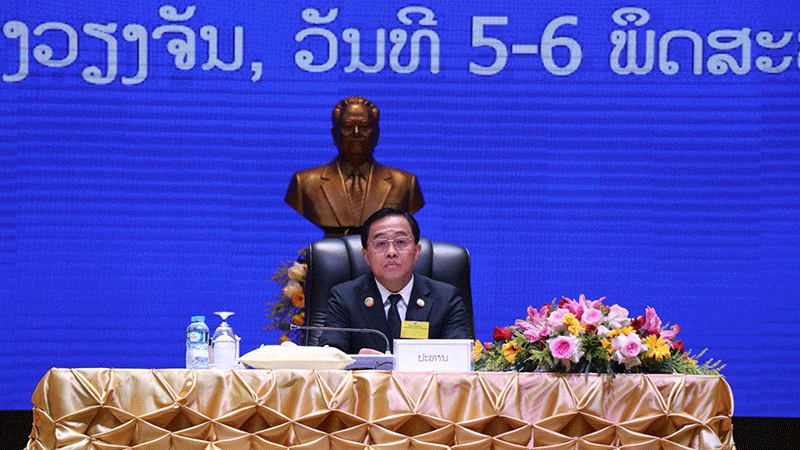
| Minister of Public Works and Transport, Mr Leklai Sivilay, chairs a planning meeting on Tuesday. |
Transport plan drives Laos closer to becoming regional hub
The Ministry of Public Works and Transport has unveiled a five-year plan to turn Laos into a regional logistics hub, while also tightening control of development projects and promoting the use of electric vehicles.
The plan, covering the years 2026 to 2030, was announced at the ministry’s national work conference held at the National Convention Centre on May 5 and chaired by Minister of Public Works and Transport, Mr Leklai Sivilay.
The strategy aims to build on Laos’ landlocked status by turning the country into a land-linked hub for regional and international transport, trade and investment, in line with the government’s policy to create a self-reliant economy.
Under the new plan, the ministry is aiming for annual growth of 5 percent in road and air transport, and 10 percent in rail services. To support this, five dry ports will be constructed in Huayxai, Luang Prabang, Natuey, Pakxan and Laksao (KM20), along with inland container depots at Saysettha and Dansavanh.
The ministry also plans to upgrade key international border crossings, and improve 1,450 kilometres of ASEAN highway to meet regional freight transport standards.
The plan also outlines several major infrastructure projects to strengthen regional connectivity. Authorities aim to complete the Pakxan–Lao-Vietnam border expressway and the Xiengmen–Luang Prabang bridge across the Mekong River, both seen as key links for trade and travel.
Rail development is another priority, with plans to expand the network to neighbouring countries. Work is expected to begin on a new railway line connecting Thakhek district in Khammuan province with Naphao at the Lao-Vietnam border.
In the north, the government aims to build a river port at Xiengkok in Long district, Luang Namtha province, designed to handle cargo vessels of between 300 and 500 tonnes, improving river transport capacity.
The ministry also plans to complete a feasibility study on improving navigation along the Mekong River from Vientiane to the Lao-Cambodia border, which could open new opportunities for inland water transport and cross-border trade.
The ministry reported strong results in 2025, with 15.58 million tonnes of freight handled and 89.63 million passenger trips recorded nationwide.
Infrastructure upgrades included repairs to Route 13 North and South, the opening of the 5th Lao-Thai Friendship Bridge linking Pakxan and Bueng Kan, and progress on construction of the Thakhaek Dry Port. A Bus Rapid Transit system also began trial operations in Vientiane.
Mr Leklai highlighted 11 priority areas to address the main challenges in the sector. These include improved road maintenance, greater private sector involvement, and changes to the Road Fund to improve efficiency at the district level.
The ministry will also expand digital systems across the sector and improve coordination between central and local authorities to ensure services reach local communities more effectively.
uthorities will take action against overloaded trucks, speeding, and the unsafe transport of construction materials such as soil, sand and rocks.
The ministry will also strengthen controls on river transport, including passenger boats and tourist vessels, to ensure safety. In addition, tighter rules will govern sand and gravel extraction to prevent illegal activities such as unauthorised gold mining.
In line with global green trends, the ministry is promoting the use of electric vehicles, aiming for them to comprise 30 percent of the national vehicle fleet by 2030. The goal is to reduce Laos’ heavy reliance on fuel imports, save foreign currency, and make more use of the abundant electricity generated in Laos.
The conference continues until May 6 and will be attended by Prime Minister Sonexay Siphandone, who is expected to provide guidance on the sector’s future direction.
The ministry said the plan will help attract foreign investment, boost cross-border trade, and create jobs, while supporting the government’s goal of building an independent and self-reliant economy.
By Times Reporters
(Latest Update May 6, 2026)
|

